Mag-iwan ng Mensahe
Kung interesado ka sa aming mga produkto at gusto mong malaman ang higit pang mga detalye, mangyaring mag-iwan ng mensahe dito, sasagutin ka namin sa lalong madaling panahon.

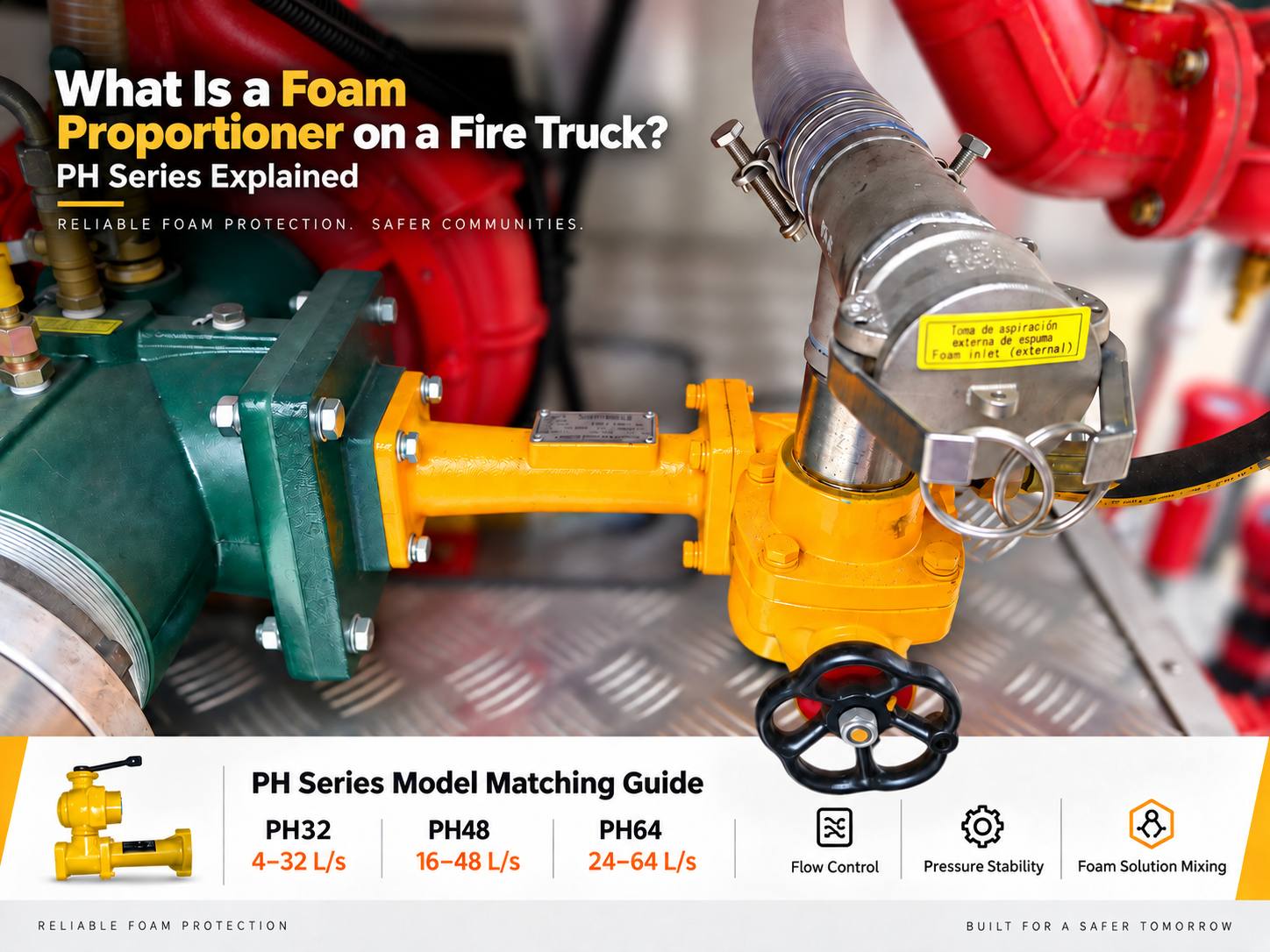
The PH series around-the-pump foam proportioner is a professional foam concentrate suction and delivery device designed specifically for foam firefighting systems and fire trucks. It is installed within the supporting fire truck fire pump and water supply system and serves as the core device for achieving automatic proportional mixing of foam concentrate and clean water.
Unlike traditional manual mixing equipment, this proportioner operates on the principle of water pressure differential: according to the selected flow rate setting, it draws a precise amount of foam concentrate from the foam tank, delivers the foam concentrate to the fire pump inlet, and thoroughly mixes it with pressurized water to form a uniform foam solution. The properly mixed solution is then delivered to foam-generating devices or discharge equipment for efficient firefighting operations.
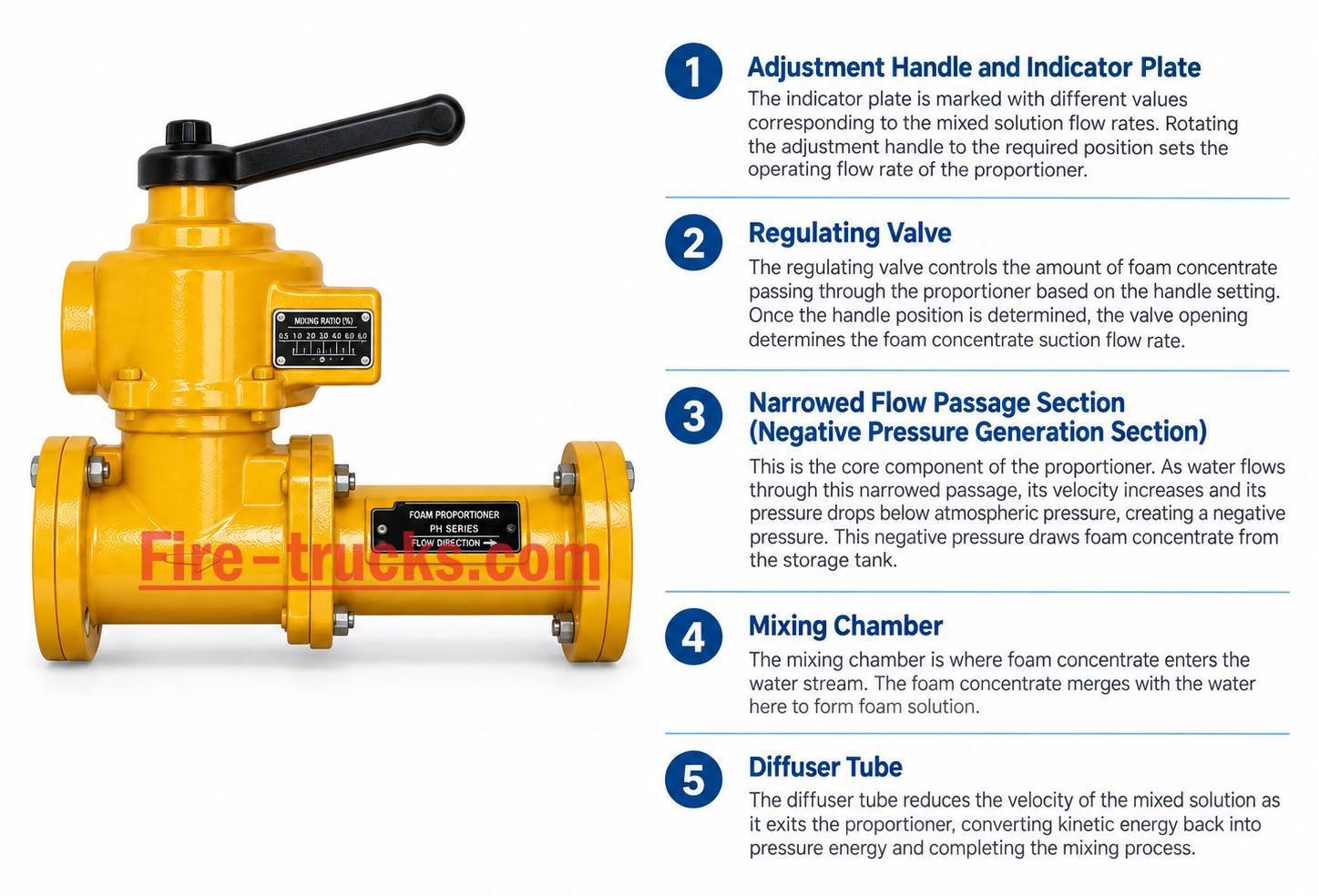
1. Adjustment Handle and Indicator Plate
The indicator plate is marked with different values corresponding to the mixed solution flow rates required by the connected foam-generating devices. Rotating the adjustment handle to the required flow rate position sets the operating flow rate of the proportioner.
2. Regulating Valve
The regulating valve controls the amount of foam concentrate passing through the proportioner based on the handle setting. Once the handle position is determined, the valve opening determines the foam concentrate suction flow rate.
3. Narrowed Flow Passage Section (Negative Pressure Generation Section)
This is the core component of the proportioner. As water flows through this narrowed passage, its velocity increases and its pressure drops below atmospheric pressure, creating a negative pressure. This negative pressure is transmitted to the foam concentrate suction port, drawing foam concentrate from the storage tank.
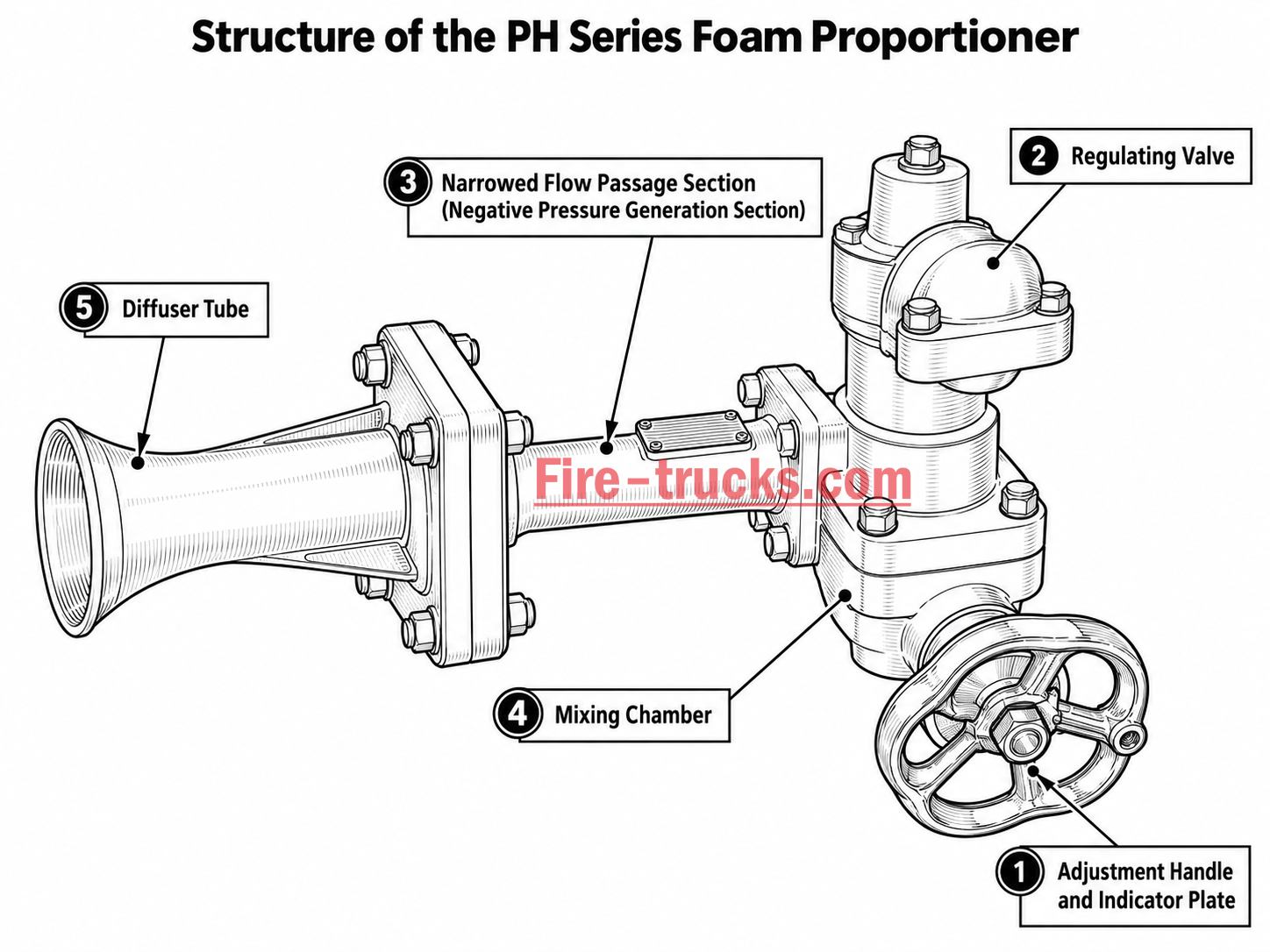
4. Mixing Chamber
The mixing chamber is where foam concentrate enters the water stream. The foam concentrate merges with the water here to form foam solution. An arrow cast on the mixing chamber exterior indicates the flow direction—the arrow tail connects to the pump discharge line, and the arrow head connects to the pump inlet line.
5. Diffuser Tube
The diffuser tube reduces the velocity of the mixed solution as it exits the proportioner, converting kinetic energy back into pressure energy so that the mixed solution enters the pump inlet line at an appropriate pressure.
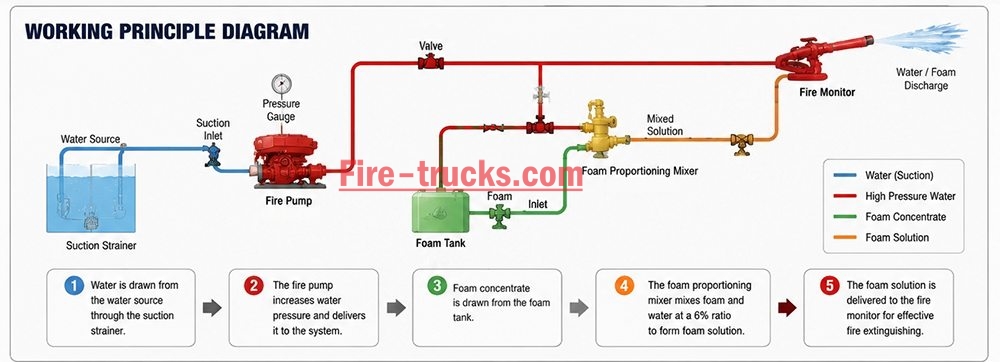
The PH series around-the-pump foam proportioner uses the water flow and pressure conditions within the fire pump system to draw foam concentrate from the foam tank, introduce it into the fire pump inlet, and mix it with water to form foam solution. The fire pump then pressurizes the mixed solution again and delivers it to downstream foam discharge equipment.
Step 1: The fire pump pressurizes the water
Water enters the fire pump from the fire truck's water tank or another suitable water source. The fire pump pressurizes the water and delivers it through the discharge line.
Step 2: A portion of pressurized water enters the proportioner
A portion of the pressurized water from the fire pump discharge side is diverted to the foam proportioner. This pressure and flow condition provides the necessary operating conditions for the proportioner to draw foam concentrate from the foam tank. The proportioner is typically installed near the fire pump and connected to the pump inlet and discharge lines according to the system configuration.
Step 3: The proportioner controls foam concentrate flow
As water flows through the proportioner, its internal flow passages and regulating mechanism create the conditions needed to draw foam concentrate. The operator selects the appropriate operating setting using the adjustment handle and indicator plate. Different values on the indicator plate correspond to the mixed solution flow rates required by the connected foam generators or discharge devices. For example, the PH64 proportioner provides different adjustment settings corresponding to 24, 32, 48, and 64 L/s mixed solution flow rates.
Step 4: Foam concentrate is drawn from the foam tank
Foam concentrate flows from the foam tank through the foam inlet line into the proportioner. The proportioner controls the foam concentrate flow rate based on the selected setting and the actual operating conditions of the firefighting system.
Step 5: Mixed solution returns to the fire pump inlet
The foam concentrate enters the system and mixes with the water flow. The resulting foam solution then flows to the fire pump inlet. The fire pump pressurizes the mixed solution again and delivers it through the discharge line to downstream firefighting equipment, such as:
• Foam fire monitors
• Foam nozzles
• Foam generators
• Other compatible foam discharge devices
The entire working process can be simplified as:
Water tank → Fire pump → Foam proportioner → Fire pump inlet → Fire pump → Foam discharge equipment
The PH series is available in three main models: PH32, PH48, and PH64, where the number indicates the maximum foam solution flow rate in liters per second.
Common operating parameters:
| Parameter | Specification |
| Inlet working pressure (pump discharge) | 0.6–1.4 MPa |
| Outlet working pressure (pump inlet) | < 0.03 MPa |
| Mixing ratio | 6–7% (typically for 6% foam concentrate) |
| Mounting position | Near fire pump, connected between discharge and inlet lines |
Flow rate and foam concentrate suction for each model:
| Model | Handle Setting (L/s) | Foam Concentrate Drawn (L/min) | Example Foam Device |
| PH32 | 4 | 0.24 | P |
| 8 | 0.48 | PC8 | |
| 16 | 0.96 | PC16 | |
| 24 | 1.44 | PC24 | |
| 32 | 1.92 | PL32 | |
| PH48 | 16 | 0.96 | PCL8×2 |
| 24 | 1.44 | PCL8×3 | |
| 32 | 1.92 | PCL16×2 | |
| 48 | 2.88 | PL48 | |
| PH64 | 24 | 1.44 | PQ4×6 |
| 32 | 1.92 | PQ8×4 | |
| 48 | 2.88 | PQ16×3 | |
| 64 | 3.84 | PL32×2 |
Installation position: The proportioner must be installed near the fire pump, with the inlet connected to the pump discharge line and the outlet connected to the pump inlet line. The foam concentrate suction port connects to the foam tank.
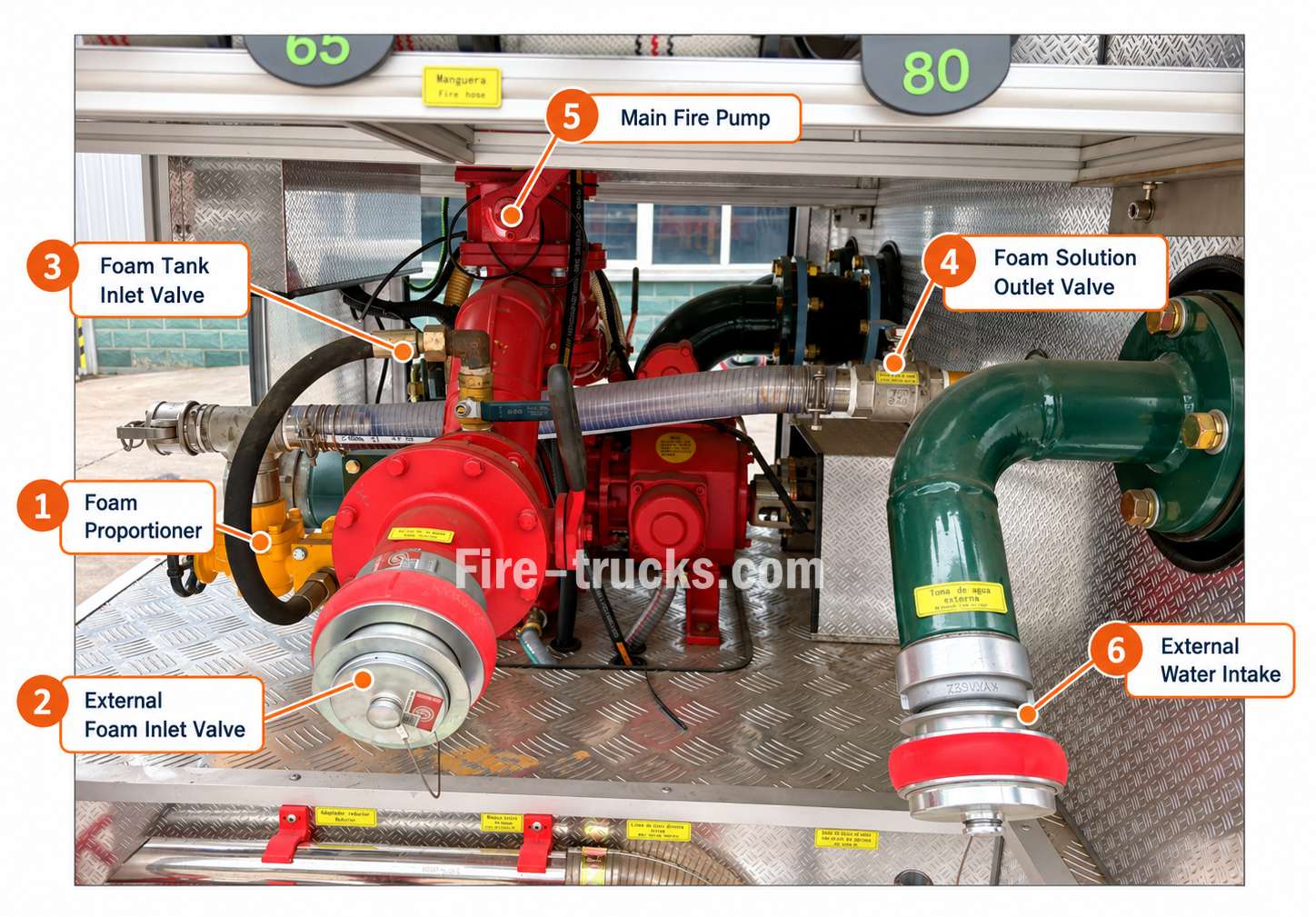
Critical installation requirement: The fire pump inlet pressure must be maintained below 0.03 MPa. This is typically achieved by ensuring adequate suction conditions and avoiding excessive pressure on the inlet side.
Pressure relationship: When the inlet pressure is within the 0.6–1.4 MPa range, the proportioner draws a relatively constant amount of foam concentrate at a given handle setting. However, if the foam-generating devices operate at different pressures, the mixed solution flow rate changes, which in turn affects the actual mixing ratio. Operators should adjust the discharge pressure of the foam-generating devices to keep the mixing ratio within the intended range (typically 6–7% for 6% foam concentrate).
Maintenance: After each use, flush the proportioner with clean water to prevent foam concentrate residue from causing corrosion or blockage. Periodically inspect the adjustment handle and indicator plate for smooth operation.
Whether a foam proportioner works properly depends closely on system pressure conditions and the configuration of valves, piping, and equipment.
| Problem | Possible Cause | Recommended Check |
| Foam concentrate not drawn | Fire pump inlet pressure too high | Check fire pump inlet pressure |
| Unstable foam concentrate output | Incorrect operating conditions | Check fire pump and discharge pressure |
| Foam mixing ratio changes | Mixed solution flow rate changes | Check downstream equipment flow and pressure |
| Insufficient foam concentrate flow | Valve or piping problem | Check foam inlet valve and piping |
| Abnormal proportioner adjustment | Incorrect adjustment setting | Check adjustment handle and indicator plate |
| Foam system fails to achieve expected performance | Equipment mismatch | Check compatibility between proportioner and discharge devices |
Q1: How does a fire truck foam proportioner work?
A: The proportioner draws foam concentrate through its internal flow passages and regulating mechanism, delivers it to the fire pump inlet, mixes the foam concentrate with water, and then sends the mixed solution to downstream foam equipment.
Q2: Why can't the fire truck foam proportioner draw foam concentrate?
A: The most common cause is that the pump inlet pressure exceeds 0.03 MPa, or there is a blockage in the piping or a valve not fully open. Check inlet pressure and piping flow first.
Q3: What is the difference between PH32, PH48, and PH64 foam proportioners?
A: The main difference is the supported mixed solution flow rate range. PH32 reaches a maximum of 32 L/s, PH48 reaches 48 L/s, and PH64 reaches 64 L/s.
Q4: What should the fire pump inlet pressure be?
A: The fire pump inlet pressure should be maintained below 0.03 MPa, because excessive inlet pressure can affect the proportioner's ability to draw foam concentrate.
Q5: What is the difference between an around-the-pump proportioner and a balanced-pressure proportioner?
A: The around-the-pump type (PH series) relies on the fire pump's own pressure differential to create negative pressure and draw foam concentrate. It has a simple structure and low cost, but the mixing ratio is more affected by changes in pump inlet pressure and foam-generating device flow rate. A balanced-pressure proportioner uses an independent foam pump to actively inject foam concentrate into the water stream, offering higher mixing accuracy and a wider flow adaptation range, but with a more complex structure and higher cost. Selection should be based on system accuracy requirements and budget.
Q6: After the proportioner handle is set, why does the actual mixing ratio still change?
A: Within the 0.6–1.4 MPa inlet pressure range, the proportioner draws a relatively constant amount of foam concentrate at a given setting. However, when foam-generating devices operate at different pressures, their mixed solution flow rate changes. When the equipment flow rate deviates from the proportioner handle setting, the actual mixing ratio changes accordingly. Operators should adjust the discharge pressure of the foam-generating devices so that their flow rate matches the proportioner handle setting, ensuring the mixing ratio remains within the reasonable range of 6–7%.
As a core component of a foam fire truck's firefighting system, the working performance of the PH series around-the-pump foam proportioner directly determines the overall firefighting capability of the foam fire truck. Mastering its standard operating pressure, model matching parameters, installation specifications, pressure control requirements, and supporting valve functions is essential for fire equipment maintenance, daily commissioning, and on-site firefighting operations.


Maaari kang maging interesado sa mga sumusunod na impormasyon
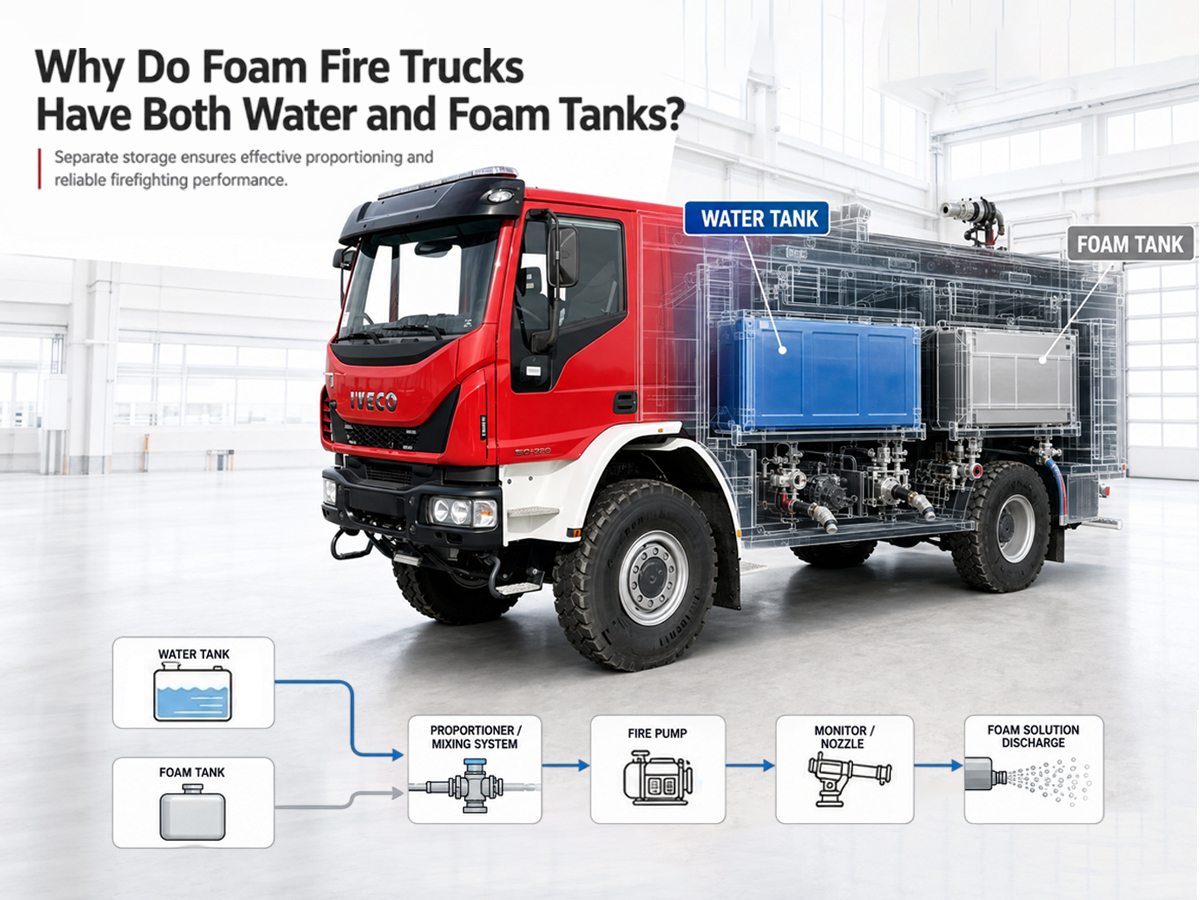
Pinagsasama ng mga foam fire truck ang isang nakalaang foam concentrate tank na may hiwalay na tangke ng tubig at isang precision proportioning system. Gumagamit sila ng proportioning system upang maglagay ng foam concentrate sa agos ng tubig sa isang tinukoy na konsentrasyon, karaniwang 1%, 3%, o 6%, depende sa foam concentrate at aplikasyon sa pag-apula ng sunog.dalawahang tangkeAng disenyo ay nagpapahintulot sa mga bumbero na gumamit lamang ng tubig kapag hindi kinakailangan ang foam at magpasok lamang ng foam concentrate kung kinakailangan. Pinapabuti nito ang kakayahang umangkop sa operasyon, nakakatulong na makontrol ang pagkonsumo ng foam, at pinapayagan ang sistema ng pag-apula ng sunog na mai-configure para sa iba't ibang panganib sa sunog. Ang pangunahing prinsipyo ng paggana at pangunahing teknolohiya ng mga foam fire truck, lalo na kung bakit mayroon silang parehong tangke ng tubig at foam—ang siyang pinagtutuunan ng pansin ng maraming customer. Alamin natin ito ngayon. Mabilis na Sagot: Karaniwang gumagamit ang mga foam fire truck ng magkahiwalay na tangke ng tubig at foam concentrate dahil ang tubig at foam concentrate ay kinakailangan sa iba't ibang proporsyon at nilayong pagsamahin habang ginagamit sa halip na iimbak bilang isang premixed solution sa mahabang panahon. Ang tangke ng tubig ang nagbibigay ng pangunahing suplay ng tubig, habang ang tangke ng foam ay nag-iimbak ng concentrated foam agent. Kinokontrol ng isang proportioning system kung gaano karaming concentrate ang ipinapasok sa daloy ng tubig, na nagpapahintulot sa trak na lumipat sa pagitan ng mga water-only at foam firefighting mode. Ako. Ano ang mga Pangunahing Bahagi ng isang Foam Fire Truck? 1. Tangke ng Tubig Konstruksyong lumalaban sa kalawang (carbon steel na may patong na anti-corrosion o hindi kinakalawang na asero), ang kapasidad ay mula 4,000 hanggang 6,000 litro. Nilagyan ng mga baffle upang mabawasan ang pag-agos ng likido habang gumagalaw ang sasakyan at mga flexible mount upang ma-absorb ang pagbaluktot ng chassis sa magaspang na daanan. 2. Tangke ng Foam Concentrate Konstruksyon na hindi kinakalawang na asero upang labanan ang pag-atake ng kemikal mula sa mga aktibong foam concentrate, karaniwang may kapasidad na 500-2,000 litro. Depende sa disenyo ng foam concentrate at sistema, ang tangke ay maaaring magsama ng mga tampok tulad ng sirkulasyon o mga kaayusan sa pag-alog upang makatulong na mapanatili ang kondisyon ng concentrate habang iniimbak. 3. Sistema ng Pagproporsyon ng Foam Isang sistema ng proporsyon na kumukuha ng foam concentrate mula sa nakalaangbulatangke at ipinapasok ito sa daluyan ng tubig sa isang tinukoy na konsentrasyon. Depende sa foam concentrate at disenyo ng sistema, ang proporsyon ay maaaring gumamit ng balanced-pressure, pump-driven, o venturi-based na teknolohiya. 4. Bomba ng Sunog Ang bomba ng bumbero ang pinagmumulan ng kuryente ng buong sistema ng foam. Ito ang kumukuha ng tubig mula sa tangke ng tubig at nagla...
Mga detalye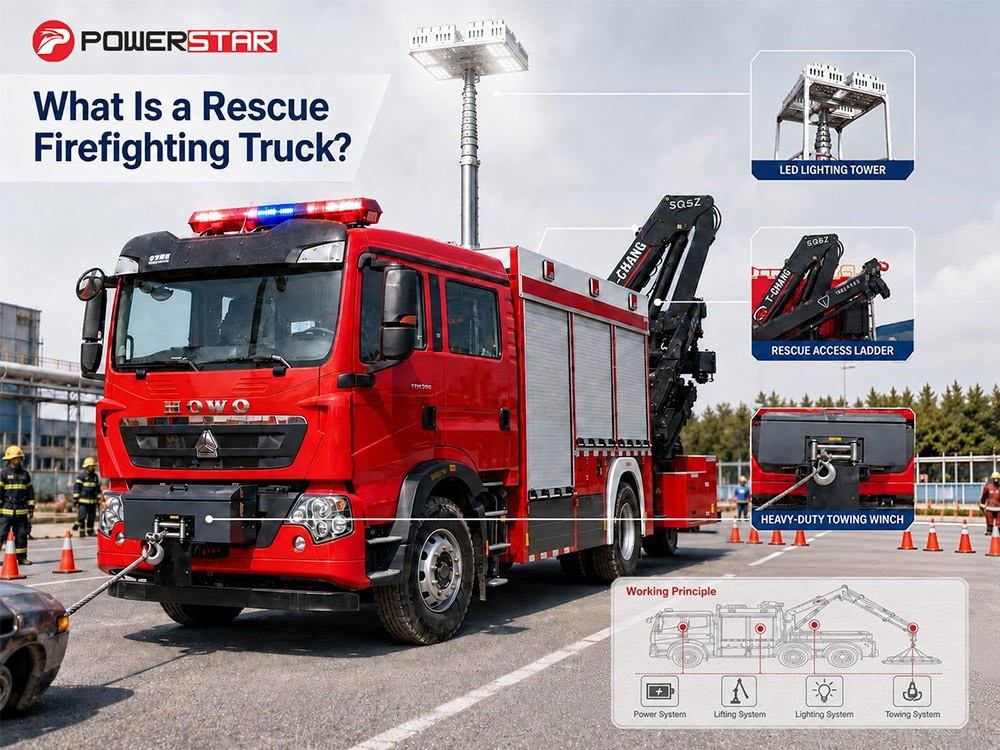
Ang rescue fire fighting truck ay isang espesyalisadong sasakyang pang-emerhensiya na idinisenyo upang magsagawa ng parehong operasyon sa pagsugpo ng sunog at pagsagip. Hindi tulad ng mga karaniwang fire truck na pangunahing nakatuon sa pag-apula ng apoy,mga trak ng bumbero na pangsagippagsamahin ang mga kagamitan sa pag-apula ng bumbero at mga kagamitan sa pagsagip, mga kagamitan sa pagbubuhat at pag-angat, mga kagamitan sa pagputol at pagkalat, mga winch, mga generator, at mga sistema ng pag-iilaw. Ipinapaliwanag ng artikulong ito kung ano ang isang rescue fire fighting truck, kung paano ito naiiba sa ibang mga kagamitan sa bumbero, anong mga kagamitan ang dala nito, at kailan ito ginagamit. I. Ano ang isang Rescue Fire Fighting Truck? Ang rescue fire fighting truck ay isang multi-purpose emergency vehicle na pinagsasama ang mga kakayahan sa pag-apula ng sunog at mga espesyal na kagamitan sa pagsagip. Pangunahin itong ginagamit upang magbigay ng komprehensibong kakayahan sa pagtugon sa emergency kapag may mga insidenteng kinasasangkutan ng mga tao, sasakyan, gusali, o mga pasilidad na pang-industriya. Depende sa konpigurasyon ng sasakyan, ang mga rescue fire truck ay maaaring may iba't ibang uri ng mga kagamitan sa pagsagip at mga sistema ng pamatay-sunog. Ang aktwal na pagpili ng kagamitan ay nag-iiba batay sa nilalayong gamit ng sasakyan. Halimbawa, ang isang sasakyan na na-configure para sa urban rescue ay maaaring may ibang layout ng kagamitan kaysa sa isang idinisenyo para sa industrial rescue, pagtugon sa lindol, o pagbangon mula sa aksidente sa trapiko sa highway. II. Anong mga Kagamitan ang Dala ng isang Rescue Fire Fighting Truck? Ang kagamitang dala ng isang rescue fire fighting truck ay nakadepende sa disenyo ng sasakyan at sa nilalayong gamit nito. Gayunpaman, ang kagamitan sa karamihan ng mga modelo ay maaaring isaayos sa ilang pangunahing kategorya: kagamitan sa pag-apula ng sunog, mga kagamitan sa pagsagip, mga kagamitang de-kuryente, kagamitan sa pag-iilaw, mga kagamitan sa pagbubuhat at paghila, at personal na kagamitang pangproteksyon. 1. Kagamitan sa Pag-apula ng Bumbero Maaaring kabilang sa mga kagamitan sa pag-apula ng sunog ang mga pamatay-sunog, mga hose para sa sunog, mga nozzle ng apoy, mga portable na bomba, mga tangke ng tubig, mga foam firefighting system, mga monitor ng sunog, at iba pang mga kagamitan sa pag-apula ng sunog. 2. Mga Kagamitang Haydroliko para sa Pagsagip Ang mga hydraulic rescue tool ay karaniwang ginagamit sa mga operasyon ng pagsagip sa aksidente sa trapiko para sa pagputol, pagkalat, o pagbubuhat ng mga nasirang istruktura ng sasakyan. Kabilang sa mga karaniwang kagamitan ang mga hydraulic cutter, hydraulic spreader, at hydraulic ram. 3. Tagabuo ng Kuryente Ang mga generator ay nagbibigay ng kuryente para sa mga kagamitan sa pagsagip, kagamitan sa pag-iilaw, mga aparato sa komunikasyon, at iba pang kagamitan kapag walang panlabas na pinagmumulan ng kuryente na magagamit sa pina...
Mga detalye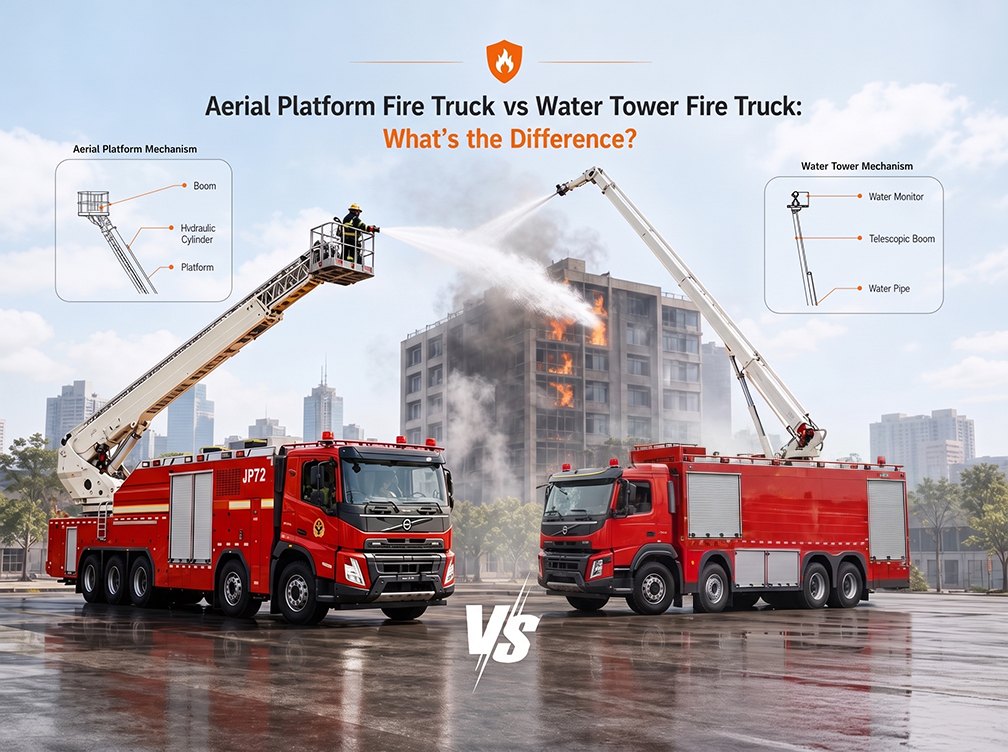
Pagdating sa paglaban sa sunog sa mga mataas na gusali, pasilidad pang-industriya, o malalaking bodega, kailangang-kailangan ang mga trak ng pamatay-sunog na panghimpapawid. Ngunit sa iba't ibang uri ng kagamitang panghimpapawid, dalawa ang madalas na nagdudulot ng kalituhan: angtrak ng pamatay-sunog na may platapormang panghimpapawid at angtrak ng pamatay-sunog na tore ng tubig. Bagama't magkahawig sila sa unang tingin—parehong may mga haydrolikong braso at dinisenyo para sa pagpapatay ng sunog sa matataas na lugar—nagsisilbi sila ng lubhang magkaibang mga misyon. Ipinapaliwanag ng artikulong ito ang mahahalagang pagkakaiba sa pagitan ng dalawang uri ng sasakyang ito, na tumutulong sa mga propesyonal sa serbisyo ng bumbero, mga tagapamahala ng pagkuha, at mga distributor ng kagamitan na gumawa ng mga may-kabatirang desisyon batay sa mga pangangailangang pang-operasyon. I. Ano ang mga Trak na may Platapormang Panghimpapawid? Ayon sa pambansang pamantayang Tsino na GB 7956.12-2015, parehong kabilang ang dalawang sasakyan sa kategorya ngmga sasakyang panlaban sa sunog na panghimpapawid—mga sasakyang nilagyan ng mga nakaaangat na braso, umiikot na mesa, at kagamitang pamuksa ng sunog para sa mga operasyon sa matataas na lugar. Gayunpaman, binibigyang-diin ng kanilang mga tiyak na depinisyon ang isang mahalagang pagkakaiba. Trak ng Pamatay-sunog na may Platapormang Panghimpapawid Ang trak ng pamatay-sunog na may platapormang panghimpapawid ay nilagyan ng natitiklop o kombinasyong natitiklop-teleskopikong braso, plataporma para sa tauhan, umiikot na mesa, at mga kagamitang pamuksa ng sunog . Ang pangunahing katangian ay angplataporma sa paggawa (balde) sa dulo ng braso, kung saan maaaring tumayo ang mga bumbero upang magsagawa ng mga operasyon ng pagsagip at pagpapatay ng sunog. Mga pangunahing katangian:• Nilagyan ng platapormang maaaring magdala ng750 libra hanggang mahigit 1,500 libra na tauhan at kagamitan• Dinisenyo para sa parehongpagsagip at pagpapatay ng sunog—maaaring direktang magpatakbo ang mga bumbero mula sa plataporma• Maaaring gamitin ang plataporma kasama ng mga aparatong kumokontrol sa pagbaba, mga haydrolikong panghila, o mga daluyang pansagip• Mas malawak na abot nang pahalang at mas malaking saklaw ng pagtatrabaho kumpara sa mga tore ng tubig II. Ano ang mga Trak ng Pamatay-sunog na Tore ng Tubig? Ang trak ng pamatay-sunog na tore ng tubig ay nilagyan ng natitiklop o kombinasyong natitiklop-teleskopikong braso, umiikot na mesa, at mga kagamitang pamuksa ng sunog—nang walang plataporma para sa tauhan. Sa halip, isang monitor ng sunog (kanyon ng tubig) ang nakakabit sa dulo ng braso, na maaaring kontrolin nang malayuan mula sa lupa. Mga pangunahing katangian:•Walang plataporma para sa tauhan—nagpapatakbo ang mga bumbero mula sa lupa sa pamamagitan ng remote control• Nakatuon lamang sapagpigil ng sunog sa matataas na lugar, hindi sa pagsagip• Naghahatid ng pambihirang lakas ng daloy ng tubig—lumalampas sa 2,000 galon bawat minutos...
Mga detalye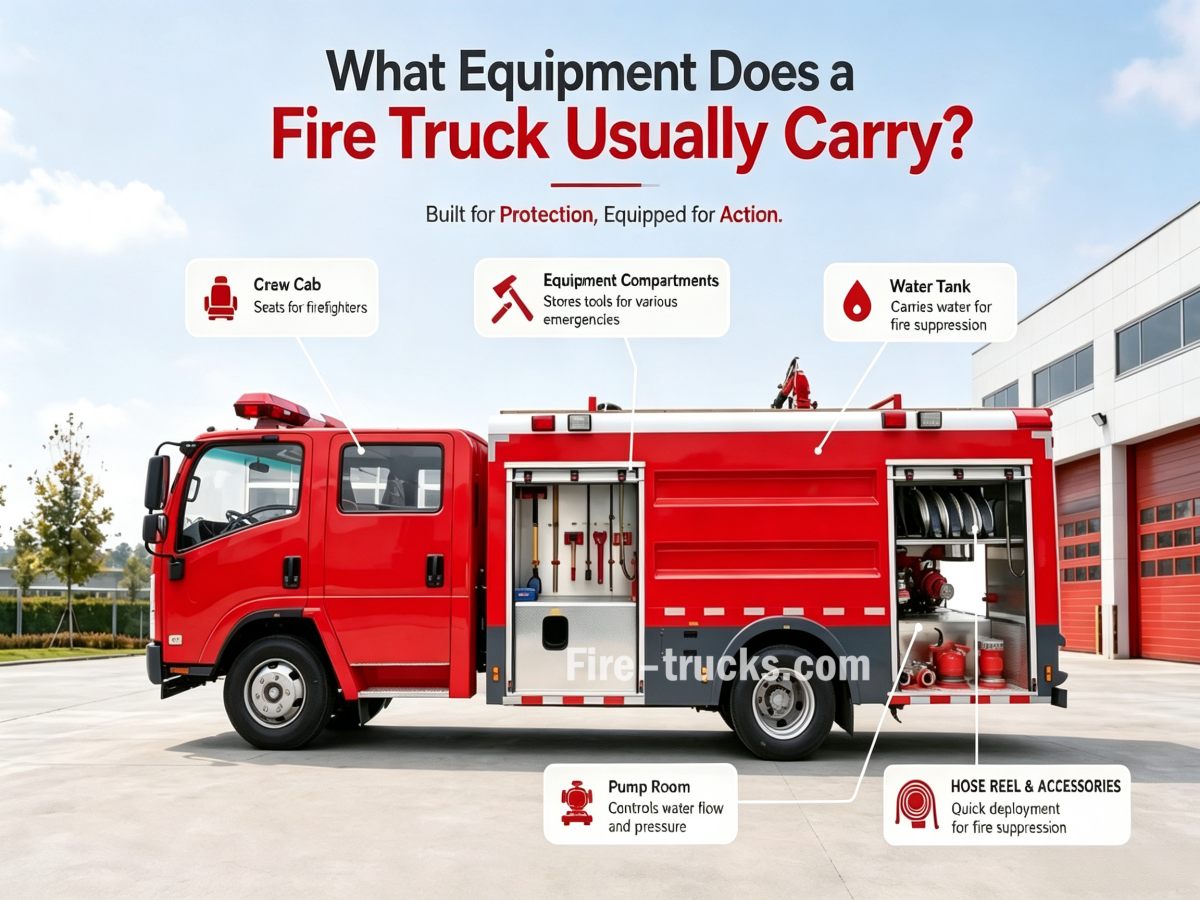
Ang isang trak ng bumbero ay karaniwang nagdadala ng mga kagamitang panlaban sa sunog, suplay ng tubig, pagsagip, at proteksiyong pangkaligtasan. Kasama sa mga karaniwang kagamitan ang mga bomba ng tubig para sa sunog, tangke ng tubig, mga hose ng pamatay-sunog, mga nguso ng buga ng tubig, mga monitor ng sunog, mga balbula, hagdan ng bumbero, mga kasangkapang pangsagip, kagamitang pamproteksiyon, at mga aparatong pangkomunikasyon. Ang artikulong ito ay sistematikong naghihimay ng klasipikasyon, mga gamit, at mga konsiderasyon sa pagpili ng pamantayangkagamitan ng trak ng bumbero , na tumutulong sa mga propesyonal sa pagkuha ng kagamitan at mga end-user na magkaroon ng ganap na pag-unawa sa mga pagsasaayos ng mga aparatong panlaban sa sunog. I. Klasipikasyon ng Kagamitan ng Trak ng Bumbero 1. Kagamitang Panlaban sa Sunog— Mga pangunahing kasangkapan para sa direktang pagpigil ng sunog, kabilang ang mga nguso ng buga ng tubig, monitor ng sunog, hose ng pamatay-sunog, mga pamahagi ng tubig, at mga adaptor. 2. Kagamitang Pagsagip at Pagbubukas ng Harang— Mga kasangkapan para sa paggawa ng mga daanan para sa mga operasyon ng pagsagip at paglaban sa sunog, kabilang ang mga haydrolikong kasangkapan sa pagsagip, palakol ng bumbero, pambukas na pingga, bareta, lagaring pangputol, at lagaring de-kadena. 3. Kagamitang Pagsagip at Pagpapanatili ng Buhay— Mga kagamitan para sa paghahanap, paglilipat, at proteksiyon ng mga tauhan, kabilang ang mga stretcher, lubid pangsagip, kawit pangkaligtasan, mga aparatong kumokontrol sa pagbaba, pansariling kagamitang panghinga (SCBA), at mga ekstrang silindro ng hangin. 4. Kagamitang Pang-alis ng Usok at Ilaw— Mga kagamitan para mapabuti ang mga kondisyon sa lugar ng sunog, kabilang ang mga pangbuga ng usok, mga mobile na tore ng ilaw, at mga portable na searchlight na may mataas na intensidad. 5. Personal na Kagamitang Pamproteksiyon (PPE)— Mga gamit para protektahan ang kaligtasan ng mga bumbero, kabilang ang mga helmet, damit na pamproteksiyon para sa istrukturang pamatay-sunog, guwantes, bota, at sinturong pangkaligtasan. 6. Kagamitang Pangkomunikasyon at Rekonosisansiya— Mga kagamitan para sa pangangalap ng impormasyon sa lugar ng sunog at koordinasyon ng pamumuno, kabilang ang mga two-way radio, thermal imaging camera, at mga detektor ng nakalalasong gas. II. Kagamitang Panlaban sa Sunog sa mga Trak ng Bumbero 1. Bomba ng Tubig para sa Sunog Ang bomba ng tubig para sa sunog ang pinagmumulan ng kapangyarihan para sa lahat ng operasyon ng paglaban sa sunog. Mekanikal nitong pinapataas ang presyon ng tubig, na nagbibigay rito ng sapat na enerhiyang kinetiko upang makumpleto ang buong proseso ng "pagkuha ng tubig → pagpapataas ng presyon → paghahatid → pagpapalabas." Karaniwang mga espesipikasyon ng bomba ng tubig para sa sunog: •Karaniwang Presyur na Bomba ng Tubig para sa Sunog (uri ng CB10/30):Daloy na ≥30L/s, nakatakdang presyon na 1.0MPa, pagkakabit sa likurang bahagi. Angkop para sa mga karaniwang trak ng tangke ...
Mga detalye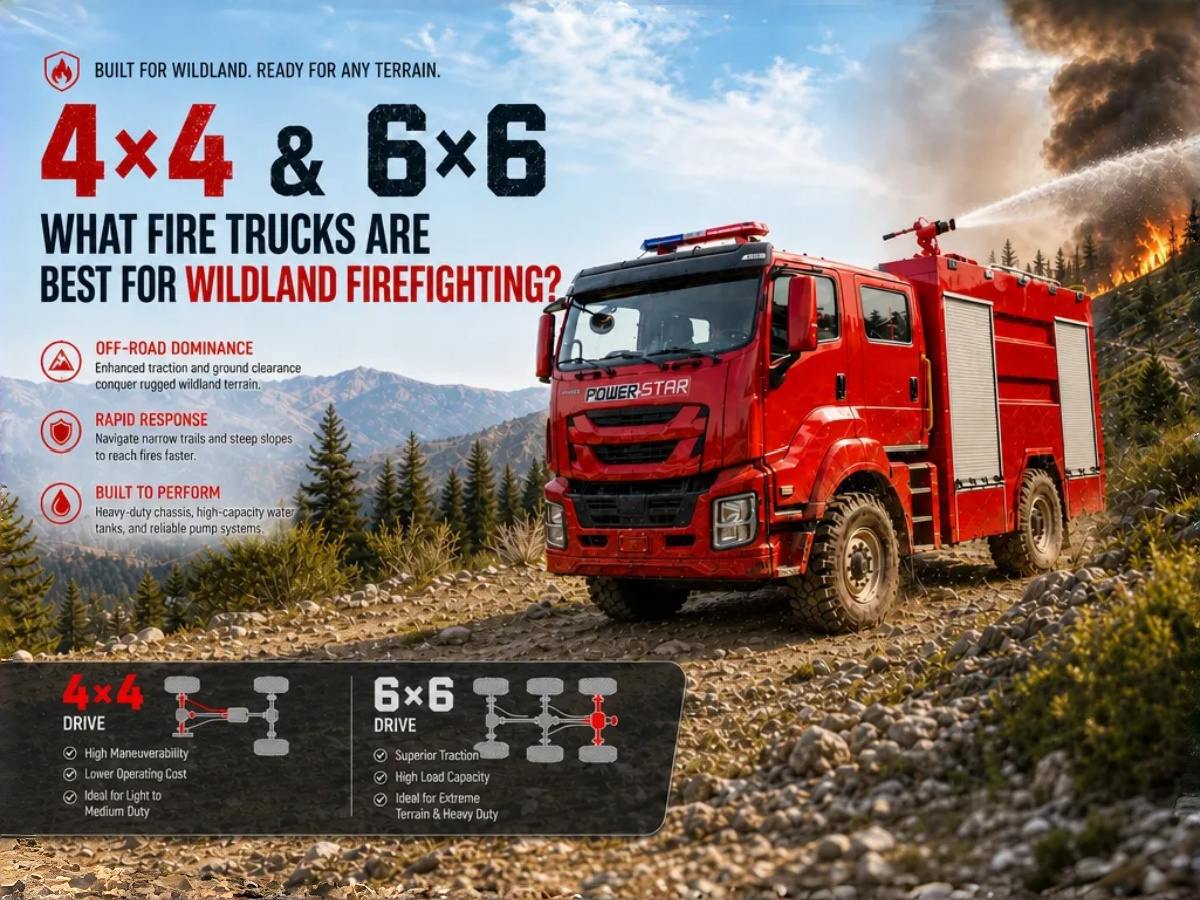
Ang paglaban sa mga sunog sa kagubatan at kaparangan ay may mga hamong pangunahing naiiba sa paglaban sa mga sunog sa gusali. Sa malalayong kagubatan, damuhan, at bulubunduking lupain, kailangang dumaan ang mga trak ng bumbero sa makikitid na daan, umakyat sa matatarik na dalisdis, at gumana nang malayo sa mga hydrant o pinagkukunan ng tubig. Ang pagpili ng tamang trak panlaban sa sunog ay isang estratehikong desisyon na direktang nakaaapekto sa oras ng pagtugon, kaligtasan ng mga tauhan, at pagiging epektibo ng pagsugpo sa sunog. Nagbibigay ang artikulong ito ng komprehensibong pagsusuri ng mga pinakaangkop na uri ng trak ng bumbero para sa paglaban sa mga sunog sa kagubatan at kaparangan, ang kanilang mahahalagang katangian, at mga paraan ng pagpili, upang matulungan kang gumawa ng tamang desisyon batay sa iyong partikular na pangangailangan sa operasyon. Mabilis na Sagot Ang mga sunog sa kagubatan at kaparangan ay nailalarawan sa malalawak na lugar ng sunog, masalimuot na lupain, limitadong pinagkukunan ng tubig, at mahihirap na kondisyon ng daan, kaya walang iisang trak ng bumbero na kayang humawak sa lahat ng sitwasyon ng sunog sa kagubatan. Sa pangkalahatan, pangunahing ginagamit sa paglaban sa mga sunog sa kagubatan at kaparangan ang mga sumusunod na uri ng trak ng bumbero: • Mga magagaan na trak panlaban sa sunog sa kagubatan at kaparangan: para sa pagdaan sa mga daan sa kagubatan at mabilis na pagtugon• Mga 4×4 na trak panlaban sa sunog sa kagubatan at kaparangan: para sa bulubundukin at maburol na lupain• Mga 6×6 na trak panlaban sa sunog sa kagubatan at kaparangan: para sa malalawak na sunog sa kagubatan at matagalang operasyon• Mga tangker ng tubig: para sa tuloy-tuloy na suplay ng tubig at suporta• Mga trak panlaban sa sunog na gumagamit ng bula: para sa mga pasilidad ng langis, kagamitang pangkagubatan, o espesyal na uri ng sunog• Mga sasakyang pangresponde: para sa komunikasyon, pag-iilaw, pagbubukas ng daan, at suporta sa logistika I. Bakit Nangangailangan ang mga Sunog sa Kagubatan at Kaparangan ng Espesyal na Trak ng Bumbero? Pangunahing naiiba ang mga sunog sa kagubatan at kaparangan sa mga sunog sa gusali sa ilang mahahalagang paraan: Mahahalagang katangian ng mga sunog sa kagubatan at kaparangan:• Malalawak na lugar ng sunog na umaabot sa ektarya ng lupain• Mabilis na nagbabagong direksiyon ng hangin• Masalimuot at mabatong lupain• Limitado o walang akses sa mga hydrant o pinagkukunan ng tubig• Makikitid at hindi sementadong mga daan sa kagubatan• Mahihirap na kondisyon sa komunikasyon Karaniwang hindi angkop ang mga karaniwang trak ng bumbero sa lungsod para sa paglaban sa mga sunog sa kagubatan at kaparangan dahil sa mga sumusunod na dahilan: • Kulang sa 4×4 o lahat-ng-gulong na sistema para sa hindi sementadong mga daang bundok at matatarik na dalisdis;• Ang mas malaking sukat at mababang layo sa lupa ay nagiging dahilan upang madali silang maipit sa makikitid na daan sa kagubatan at malambot na lupain;• Ang mga bomba sa l...
Mga detalye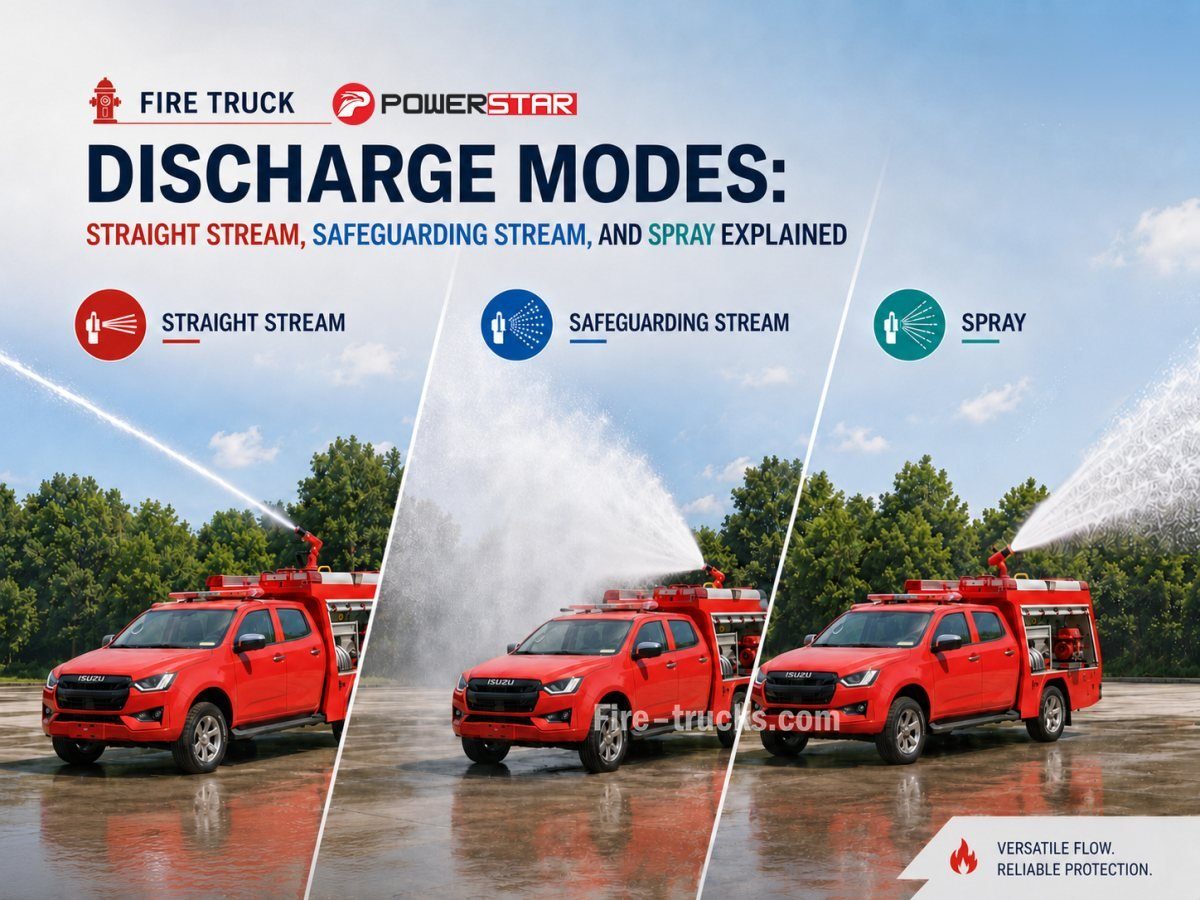
Sa mga operasyon ng pag-apula ng sunog, ang pagpili ng paraan ng pagbuga ay direktang nakaaapekto sa kahusayan ng pag-apula ng apoy, kaligtasan sa operasyon, at pagiging epektibo ng pagkontrol sa sunog. Hindi alam ng karamihan na ang trak ng bumberomga nozzle ay maaaring lumipat sa tatlong pangunahing paraan ng pagbuga: tuwid na agos, spray na agos, at proteksiyong agos. Malaki ang pagkakaiba ng bawat paraan sa anyo ng daloy, saklaw ng abot, puwersa ng tama, at lawak ng saklaw, at bawat isa ay tumutugma sa ganap na magkakaibang sitwasyon ng sunog. Ang artikulong ito, batay sa mga pamantayan ng propesyonal na operasyon sa pag-apula ng sunog, ay komprehensibong sinusuri ang mga prinsipyo, pangunahing katangian, at naaangkop na mga sitwasyon ng tatlong paraan ng pagbuga, upang matulungan ang aming mga customer na sistematikong mahasa ang mga teknik sa pagbuga ng trak ng bumbero. I. Bakit Kailangan ng mga Trak ng Bumbero ng Iba't Ibang Paraan ng Pagbuga? Ang tuwid na agos, spray na agos, at proteksiyong agos ay tumutugma sa tatlong magkaibang mekanismo ng pag-apula ng sunog: pag-apula sa pamamagitan ng puwersa ng tama, pagsakal sa pamamagitan ng singaw, at proteksiyon laban sa thermal radiation. Kailangang flexible na magpalit ang mga bumbero ayon sa kondisyon ng lugar. Kaya, bakit hindi na lang gumamit palagi ng isang uri ng agos? 1. Ang pagkakaiba-iba ng uri ng sunog ay nangangailangan ng iba't ibang anyo ng medium na pang-apula Ang iba't ibang uri ng sunog ay may magkakaibang katangian ng pagkasunog, na tumutukoy sa angkop na paraan ng pag-apula: • Ang mga sunog ng Class A na solidong materyal ay nangangailangan ng tama ng tuwid na agos upang durugin ang nasusunog na materyales at mapasok ang loob para sa pagpapalamig; • Ang mga sunog ng Class B na likido ay hindi maaaring gumamit ng tama ng tuwid na agos (dahil nagdudulot ito ng pagsabog ng likido at pagkalat ng apoy), kundi dapat gumamit ng proteksiyong agos o spray na agos para sa pagtakip at pagpapalabnaw; • Ang mga sunog ng Class E na may kuryente ay maaari lamang gumamit ng spray na agos, dahil ang maliliit na patak ng tubig ay hindi bumubuo ng tuloy-tuloy na daanan ng kuryente; • Ang mga sunog sa saradong espasyo ay nangangailangan ng spray na agos upang mapuno ang buong lugar, na nakakamit ang pag-apula sa pamamagitan ng pagsipsip ng init sa pagsingaw at pagsakal. Walang iisang paraan ang maaaring umangkop sa lahat ng uri ng sunog. 2. Ang iba't ibang yugto ng parehong sunog ay nangangailangan ng iba't ibang taktikal na paraan Kahit sa parehong sunog, ang iba't ibang yugto ay nangangailangan ng iba't ibang paraan ng pagbuga: • Sa unang yugto kapag matindi ang apoy, kailangan ang tuwid na agos para sa pangmatagalang tama sa pinagmumulan ng apoy upang mabilis itong mapigil; • Habang sumusulong, kailangan ang proteksiyong agos upang bumuo ng harang na kurtina ng tubig na humaharang sa thermal radiation at nagpoprotekta sa mga tauhan; • Bago pumasok sa isang silid, kailangan ang spray na agos u...
Mga detalye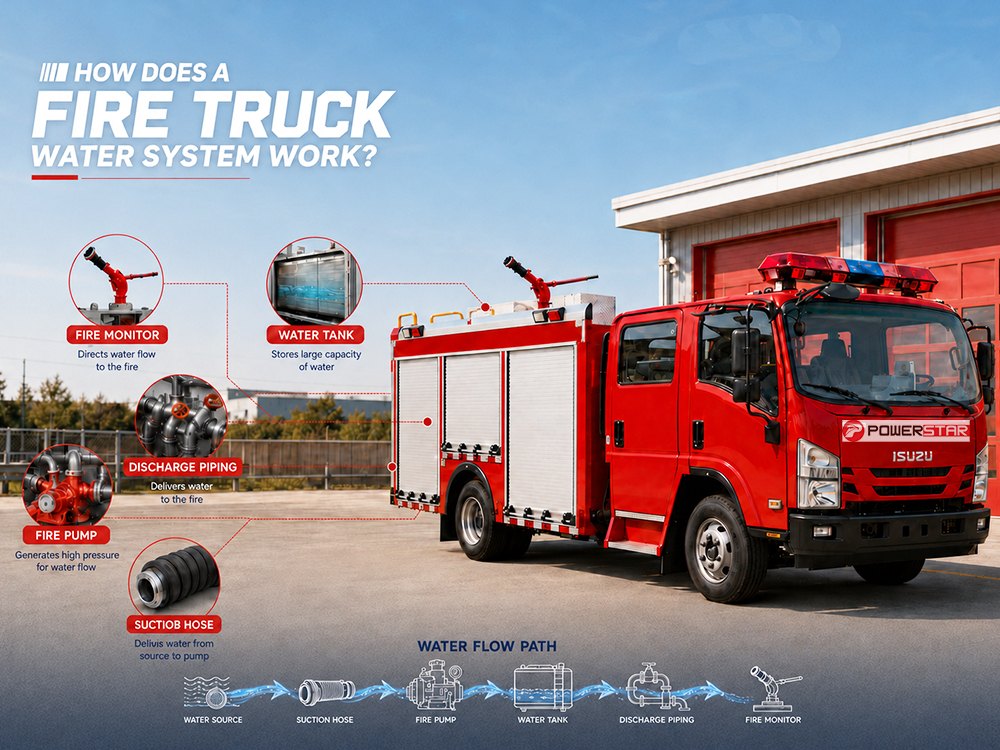
Ang sistema ng tubo ng tubig ng trak-pamatay-sunog ay ang pangunahing bahagi ng bawat operasyon sa paglaban sa sunog. Tumpak nitong dinidirekta ang tubig mula sa tangke o panlabas na pinagmumulan sa pamamagitan ng bomba, mga balbula, at mga tubo upang maghatid ng mataas na presyur na tubig o bula sa lugar ng sunog — maging ito man ay sunog sa mataas na gusali sa siksik na sentro ng lungsod o sunog sa tangke ng imbakan ng petrochemical sa sonang industriyal. Ang trak-pamatay-sunog sistema ng tubo ng tubig ay binubuo ng maraming bahaging nagtutulungan: bomba ng tubig-panlaban sa sunog, tangke ng tubig, hose ng pagsipsip, mga tubo ng paglabas, mga balbula, sangang pamamahagi, sangang pangkolekta, salaan, monitor ng sunog, mga pangkabit ng hose, at iba pa. Ang kumpletong daloy ay: Tangke ng Tubig → Hose ng Pagsipsip → Salaan → Bomba ng Sunog → Sistema ng Regulasyon ng Presyon → Kolektor ng Paglabas → Mga Balbula → Sanggang Pamamahagi → Monitor ng Sunog / Mga Pangakabit ng Hose → Buga Ipinapaliwanag ng artikulong ito ang bawat bahagi ng sistema ng tubo ng tubig at kung paano sila nagtutulungan upang maghatid ng tubig sa tamang presyon at daloy. I. Mga Pangunahing Bahagi ng Sistema ng Tubo ng Tubig Tangke ng Tubig Nag-iimbak ng suplay ng tubig na nasa sasakyan. ● Kapasidad: Karaniwang 2,000–12,000 litro. ● Paghahatid: Nagpapakain ng tubig sa bomba sa pamamagitan ng mga tubo ng pasok. ● Mga Tampok: Mga hadlang laban sa pag-alog ng tubig para sa katatagan ng sasakyan, salaan upang magsala ng mga dumi, at sistema ng pagpauna ng sipsip para kumuha ng tubig mula sa likas na pinagmumulan. Bomba ng Sunog Isang centrifugal na bomba na pinapaandar ng makina ng trak sa pamamagitan ng PTO; maaaring iisang yugto/maraming yugto, gawa sa cast iron o tanso. ● Mga antas ng presyon: Magagamit sa karaniwang rating na 0.8 MPa, 1.0 MPa, 1.2 MPa, at 1.4 MPa, na tumutugma sa karaniwang pangangailangan sa paglaban sa sunog. ● Mga antas ng daloy: Umaabot mula 1,200 hanggang 6,000 L/min, na may mga kurba ng pagganap na iniangkop para sa parehong operasyon na mataas ang presyon at mataas ang dami. Mga Balbula at Tubo Isang network ng mga tubo at balbula na kumokontrol sa direksiyon at dami ng daloy ng tubig. ● Balbula ng pasok: Ikinokonekta ang bomba sa mga panlabas na pinagmumulan ng tubig (hydrant o punto ng pagsipsip) ● Balbula mula tangke patungo sa bomba: Pinahihintulutan ang bomba na kumuha ng tubig nang direkta mula sa tangke ng sasakyan ● Mga balbula ng paglabas: Kinokontrol ang daloy ng tubig papunta sa mga hose at nozzle II. Paano Gumagana ang Sistema ng Tubo ng Tubig ng Trak-Pamatay-Sunog Hakbang 1: Pagpasok ng Tubig at Pagpapauna ng Sipsip Pumapasok ang tubig sa sistema mula sa tangke ng sasakyan, hydrant ng sunog, o likas na pinagmumulan ng tubig (mga lawa, ilog, lawa). Kapag kumukuha mula sa likas na pinagmumulan, inaalis ng sistema ng pagpapauna ng sipsip (vacuum pump) ang hangin mula sa hose ng pagsipsip, lumilikha ng vacuum na nagpapahintulot sa presyon ng atm...
Mga detalye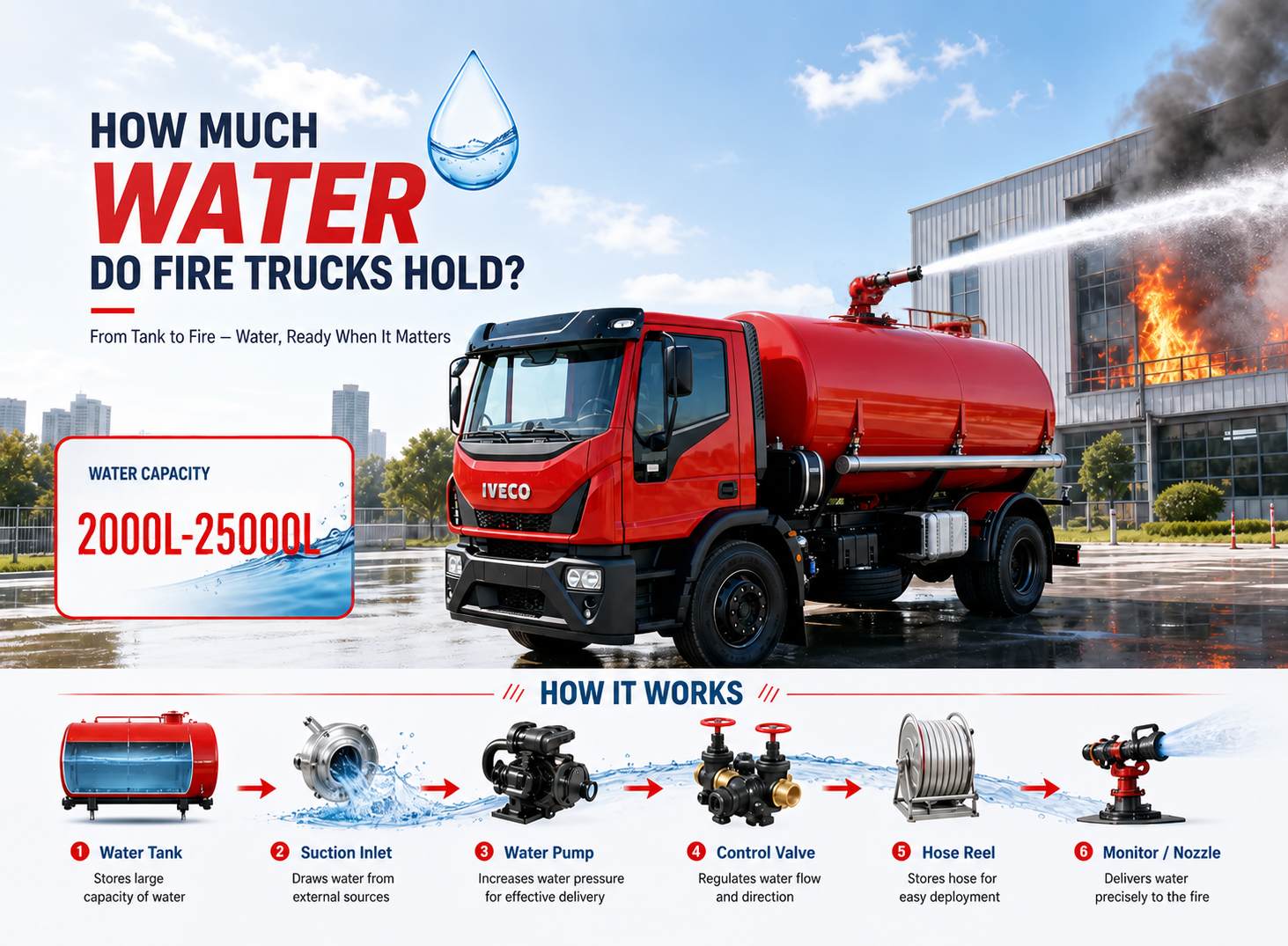
Gaano karaming tubig ang kayang dalhin ng isang trak ng bumbero? Isa ito sa mga unang tanong na kinakaharap ng aming mga customer kapag pumipili ng trak ng bumbero. Walang iisang nakapirming bilang — nakadepende ito sa uri ng sasakyan, kapasidad ng chassis, layunin ng disenyo, at mga regulasyon sa rehiyon, mula sa 2,000 litro na mga yunit na magaan ang gamit hanggang sa 25,000 litro na mga trak ng bumbero para sa industriya. Ngunit ang mas malaking tangke ay hindi palaging nangangahulugan ng mas mahusay na pagganap; sasakyang panlaban sa sunog ang kapasidad ng tangke ng tubig ay dapat na wastong itugma sa daloy ng bomba, bilis ng paglabas ng monitor, at kapasidad ng chassis upang makapaghatid ng epektibong resulta sa paglaban sa sunog. Nagsisimula ang artikulong ito sa mga pangunahing kaalaman tungkol sa kapasidad ng tangke ng tubig ng trak ng bumbero, sinusuri ang karaniwang mga saklaw ng imbakan para sa iba't ibang uri ng sasakyan, tinatalakay ang mahahalagang salik na nakaaapekto sa disenyo ng tangke, at nagbibigay ng praktikal na gabay sa pagbili. Mahahalagang Punto: Ang kapasidad ng tangke ng tubig ng trak ng bumbero ay karaniwang nasa saklaw na 2,000 hanggang 25,000 litro Magkakaiba ang kapasidad ng tangke ng iba't ibang uri ng trak ng bumbero Ang mas malaking tangke ay hindi nangangahulugan ng mas mahusay na kakayahan sa paglaban sa sunog Ang kapasidad ng tangke ay dapat itugma sa daloy ng bomba, daloy ng monitor, at kapasidad ng chassis Karaniwang nangangailangan ang paglaban sa sunog sa industriya ng malalaking tangke, habang inuuna ng paglaban sa sunog ng mga munisipalidad ang madaling pagkilos » I. Tatlong Pangunahing Uri ng Tangke ng Tubig ng Trak ng Bumbero Mga Trak na may Bomba:Ito ang pinakakaraniwang mga trak ng bumbero ng munisipalidad. Pangunahing umaasa ang mga ito sa mga fire hydrant para sa suplay ng tubig at nagdadala ng humigit-kumulang 1,900–3,800 litro ng tubig sa sasakyan para sa paunang pag-atake. Ang pangunahing bahagi ng mga sasakyang ito ay ang bomba, hindi ang tangke — dinisenyo ang mga ito upang maghatid ng may presyong tubig kapag nakakonekta na sa fire hydrant. Mga Tangker na Trak (Mga Tagapagdala ng Tubig):Ang mga sasakyang ito ay nakalaan sa pagdadala ng malalaking dami ng tubig, na may kapasidad ng tangke na karaniwang lampas sa 11,400 litro. Mahalaga ang papel nila sa mga rural at liblib na lugar kung saan walang mga fire hydrant, dahil naghahatid sila ng tubig mula sa mga pinagmumulan ng tubig patungo sa lugar ng sunog para gamitin ng mga trak na may bomba. Mga Trak na may Bomba at Tangke:Pinagsasama ng mga sasakyang ito ang mga tungkulin ng pagbomba at pagdadala ng tubig sa isang yunit. Maaari silang parehong maglabas ng tubig para sa paglaban sa sunog at magsuplay sa ibang mga sasakyan. Karaniwang nasa 5,700 hanggang 11,400 litro ang kapasidad ng tangke, kaya maraming gamit ang mga ito para sa mga kagawaran ng bumbero. » II. Gaano Karaming Tubig ang Kayang Dalhin ng Iba't Ibang Uri ng Trak ng Bumbero? Uri ...
Mga detalye
Mangyaring magpatuloy sa pagbabasa, manatiling nakaantabay, mag-subscribe, at malugod naming hinihintay ang inyong mga komento.

 Suportado ang network ng IPv6

 Filipino
 English
 français
 Deutsch
 русский
 italiano
 español
 português
 Nederlands
 العربية
 日本語
日本語 한국의
한국의 Türkçe
 Melayu
 ไทย
ไทย Tiếng Việt
 Indonesia
  中文
中文 қазақ
қазақ မြန်မာ
 српски